Gol Gumbaz
Address
Vijayapura, Karnataka
Open Hours
10:00 AM–5:00 PM
Weather
Warm and dry, best visited between October and March for a pleasant experience.
Crowd Level
Medium
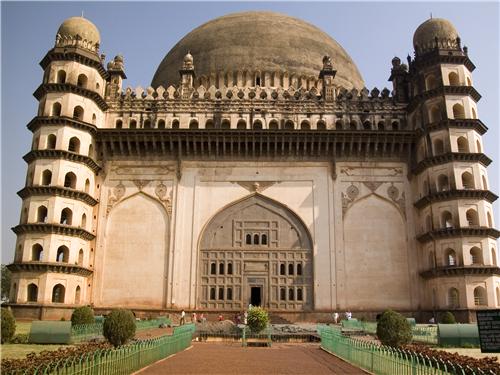
Gol Gumbaz, located in the historic town of Vijayapura (formerly Bijapur) in Karnataka, is one of India's most breathtaking architectural wonders. Often referred to as the 'Taj Mahal of South India', it serves as the mausoleum of Mohammed Adil Shah, the seventh ruler of the Adil Shahi dynasty. Construction began in 1626, shortly after the Sultan ascended the throne, and continued throughout his reign until his death in 1656. The structure is a masterpiece of the Deccan Indo-Islamic style, reflecting a unique confluence of Persian, Mughal, and indigenous Dravidian influences.
The grandeur of the structure lies in its immense scale. It is a massive dark grey basalt cube topped by a hemispherical dome that stands as the second-largest in the world, surpassed only by St. Peter's Basilica in Rome. The dome covers an internal area of approximately 1,700 square meters—the largest single-chamber space covered by a dome anywhere on the globe. Architect Yaqut of Dabul engineered the building to rest on bedrock, employing the unique technique of pendentives to distribute the immense weight of the dome, a structural innovation not seen elsewhere in India at the time.
One of the most famous features of the monument is the 'Whispering Gallery' located at the dome's base. This acoustic marvel is designed such that even a faint tick of a watch or a whisper can be heard clearly from across the diameter of the dome, nearly 37 meters away. The echo system is so precise that any sound is reflected and amplified over eleven times, leaving visitors in awe of the medieval civil engineering prowess. Staircases inside the four seven-story octagonal towers at the corners grant access to this gallery and provide panoramic views of the surrounding city.
The monument complex is a tranquil space that houses the graves of the Sultan, his wives Taj Jahan Begum and Aroos Bibi, his mistress Rambha, his daughter, and his grandson. The complex also features a mosque, a dharamshala (rest house), and a Nakkar Khana, which now functions as a site museum. An intriguing historical artifact preserved here is the 'bijlipathar', a meteorite fragment believed by locals to possess protective properties against lightning. The well-maintained gardens surrounding the mausoleum offer a serene atmosphere for tourists and history enthusiasts alike to reflect on the legacy of the Adil Shahi dynasty.
Visitor Information
Famous For
World's second-largest dome, the Whispering Gallery acoustic effect, unique Indo-Islamic architecture, and historic mausoleum.
Visit Duration
2–3 hours
Best Time
Early morning or late afternoon to avoid peak sun and heat.
Route Options
Vijayapura is well-connected by rail and road. The site is 2 km from the Bijapur Railway Station and easily accessible by auto-rickshaw or taxi.
Parking
Large designated parking area available near the entrance for two-wheelers and cars.
Entry Fee
Rs. 10 for Indian nationals, Rs. 100 for Foreign nationals.
Camera Fee
Included in the entry ticket; no extra charge for hand-held cameras.
Restaurants Nearby
Several local vegetarian and multi-cuisine restaurants located within the city center.
Toilets
Public restrooms are available near the main gate and entrance office.
Drinking Water
Filtered water stations are available near the site entrance.
Wheelchair Access
Partial accessibility; ramps are available to reach the main podium, but upper levels require climbing steep, winding stairs.
Medical Facilities
First aid available on-site; District Hospital is within 3 km.
Weather Alerts
Summers (March to May) can be extremely hot; maintain hydration.
Pilgrim Information
Darshan Timings
Not applicable as it is a historical site, however, the site is open for visitors from 10:00 AM to 5:00 PM.
Special Poojas
None, as this is a secular historical monument and not a functioning religious shrine.
Prasadam
Not applicable.
Free Meals (Bhojan)
Not applicable.
Temple History
The site holds deep historical significance as the royal burial ground of the Adil Shahi dynasty, representing the zenith of their power and architectural influence.
Nearby Sacred Places
Ibrahim Rauza, Malik-e-Maidan cannon, and various historic mosques in the old city.