Savadatti
Address
Renuka Yellamma Devi Temple, Saundatti
Open Hours
6:00 AM–1:00 PM, 3:30 PM–9:00 PM
Weather
Warm during the day, pleasant mornings and evenings from October to February. Hot and dry from March to May. Humid and wet during monsoon (June to September).
Crowd Level
Medium
The off-shoots of the Western Ghats which cover this area have given rise to seven hillocks, of which Yellamma Gudda is an important one. Naturally, the goddess came to be known as ‘Yellamma of the Seven hills’. The place name is mentioned repeatedly as ‘Sugandhavarthi’ and also ‘Soundaryavarti’. In the earlier period, under the rule of the Bhaisas and later under the Rattas, it was a celebrated Jain centre. It was also the original capital of the Rattas, who flourished between the 12th and 13th centuries. Later, when the capital was shifted to Venugrama (the present city of Belgaum), Savadatti lost its significance as a seat of administration.
According to mythology, the sage Jamadagni and his wife Renuka lived in their ‘ashrama’ near the hillock on the banks of the river Malaprabha. The story goes to say that sage Jamadagni once became furious and bade his children to chop off the head of Renuka, which his fourth son Parashurama did. However, Renuka was resurrected by Jamadagni.
Later, Karthaveerarjuna killed Jamadagni in order to snatch away the celestial cow ‘Kamadhenu’. Although sage Jamadagni was revived later, his wife Renuka had to suffer widowhood for four days. Renuka is now considered as a ‘Shakti’ deity and worshipped here as ‘Yellamma Devi’.
There are three sacred ponds known as ‘Jogula bavi’. ‘Yenne konda’ and ‘Arisina konda’, cut out of solid rock near the temple itself. The water in these ponds is believed to contain curative properties, particularly for skin diseases. Generally, the pilgrims bathe in these ponds before entering the temple. The neem leaves have also great significance in this temple. In the olden days, the devotees used to enter the temple almost naked, covering the body only with the sheaves of neem leaves. The British Government banned that ritual holding that it was obscene.
Camphor, salt, oil, coconuts and plantains are the main offerings to the deity. During ‘pooja’ time, the temple premises echo and resound with the cry of‘Udho, Udho’ and the beating of a special drum. The temple does not conduct any extravagant ceremonies as such. The idol of Yellamma is decorated with different types of jewelry and a good number of sarees offered by the devotees.
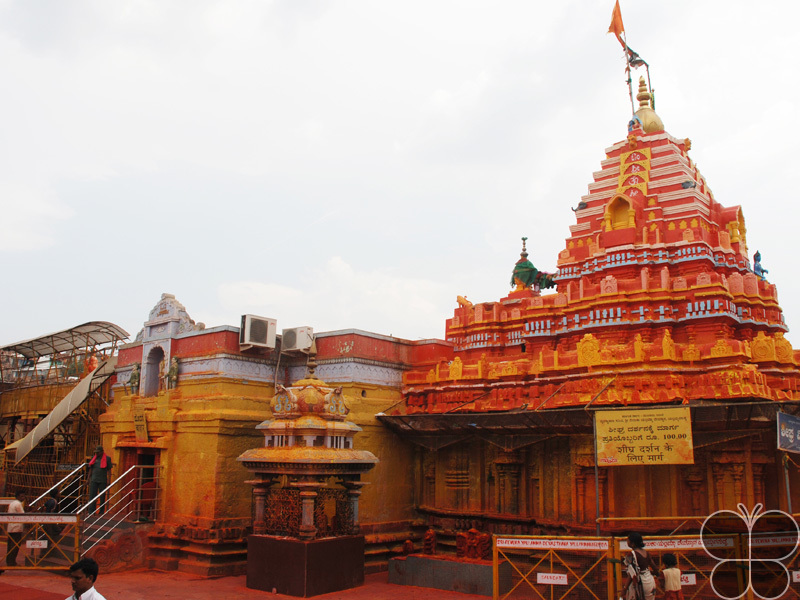
The temple of Yellamma is constructed in an ancient Dravidian style with a ‘mukha mandapa, navaranga, sukanasi’, an inner ‘sanctum’ and the usual ‘pradakshina patha’. it is enclosed by high walls and has three big main entrances. Outside, there are separate temples for Parasurama and his father Jamadagni, obviously of very recent origin. The temple itself is devoid of any significant architectural grandeur.
From the historical and archaeological point of view, it is believed that the ancient shrine belonged to the Jaina school of the 16th century, as evidenced by the sculpture on the pillars. The idol of the main deity itself does not appear to have the characteristics of a Hindu goddess, as she holds a lotus flower in her hand, similar to Padmavati Devi, the Jaina Deity.
One of the edicts, discovered in this temple a few decades ago, refers to this goddess as ‘Jataka’. It is beyond doubt that Jaina religious influence played a prominent part at that time. During the reign of Krishnadevaraya of Vijayanagar, Tirumala Nayaka, one of his feudatories is said to have renovated the shrine and beautified it with lamp pillar, ‘Mahadwara’. etc., in 1515 A.D.
Legends and myths apart, in time, the temple came to be associated with the Devadasi cult which has caused untold misery to many a dalit woman in North Karnataka. In the olden days, the Devadasi was the mistress of a single man. She was a prestigious acquisition even though her feudal lord would eventually abandon her for another. With the arrival of the modern age, there was more money in circulation and rural communities were vulnerable and exposed. In a matter of decades the Devadasis became prostitutes. However, the bad system has now been banned and rehabilitation work has been taken up in the Karnataka State.
The annual fair during the month of‘Chaitra’ (February) attracts lakhs of pilgrims and visitors. All the roads leading to Savadatti during that season resound with the noisy refrain of jingles of the bullock carts and the prayers of pilgrims.
Savadatti is only 37 kms. north of Dharwad, and 85 kms. west of Belgaum. it is connected by excellent roads from all sides. State Road Transport buses and private vans operate in this route at frequent intervals. Taxi or jeep can be hired at Belgaum or Dharwar.
There are a few Choultries, Dharmashalas and rest houses at Savadatti, but is preferable to stay either at Belgaum or Dharwad, where there are very convenient lodgings and rest houses.
Visitor Information
Famous For
Renuka Yellamma Devi Temple, ancient pilgrimage site, sacred ponds with curative properties, historical Jain center, annual Chaitra fair, mythological significance.
Visit Duration
2–3 hours
Best Time
October to March for pleasant weather. Full moon days (September-April), Tuesdays, and Fridays for peak spiritual experience. Chaitra fair (February) for vibrant atmosphere.
Route Options
Savadatti is 37 km north of Dharwad and 85 km west of Belgaum. Excellent roads connect it to both cities. KSRTC (State Road Transport) buses and private vans operate frequently. Taxis or jeeps can be hired from Dharwad or Belgaum.
Parking
Large open-air parking lots are available near the temple base, accommodating cars and buses. Additional parking may be arranged during major festivals.
Entry Fee
Free entry to the temple.
Camera Fee
No specific camera fee mentioned; generally free for personal photography, but prohibited inside the inner sanctum.
Restaurants Nearby
Numerous small vegetarian eateries and local food stalls are available near the temple and in Savadatti town. Larger multi-cuisine restaurants are in Dharwad and Belgaum.
Toilets
Basic public toilets are available near the parking area and temple complex, may not be meticulously maintained.
Drinking Water
Filtered drinking water stations are available within the temple premises and near the ponds. Bottled water can be purchased from local vendors.
Wheelchair Access
Limited wheelchair access. Ramps may be available for initial sections, but steps lead to the main shrine. Assistance is recommended.
Medical Facilities
First aid centers are typically set up during major festivals. Primary healthcare centers are available in Savadatti town, and larger hospitals are in Dharwad and Belgaum.
Weather Alerts
Summers (March-May) can be very hot; carry water and stay hydrated. Monsoon (June-September) can bring heavy rains, making some paths slippery.
Pilgrim Information
Darshan Timings
Sarva Darshan (General Darshan): 6:00 AM–1:00 PM and 3:30 PM–8:30 PM daily. May be extended during festivals.
Special Poojas
Abhisheka (ritual bathing of deity) typically performed early mornings (e.g., 6:00 AM-7:00 AM). Kumkumarchana, Archana, and other sevas are available throughout the day; details and ticket counters near the entrance. Special poojas can be booked in advance or at the temple office.
Prasadam
Laddu prasadam and other devotional offerings are typically available at designated counters near the temple exit from 8:00 AM until closing.
Free Meals (Bhojan)
Free lunch (Annadanam) is often served at the temple's dining hall from approximately 12:30 PM to 2:30 PM, especially during peak pilgrim seasons and festivals.
Temple History
The Renuka Yellamma Devi Temple is steeped in mythology, linked to the legend of Renuka, wife of sage Jamadagni, and mother of Parashurama. She is worshipped here as a powerful Shakti deity. Historically, the site was a prominent Jain center and the capital of the Rattas, with the present shrine showing architectural elements and an idol suggesting early Jain influence, later renovated during the Vijayanagar period (1515 A.D.).
Nearby Sacred Places
Separate temples for Parashurama and Jamadagni adjacent to the main Yellamma Devi Temple. Other smaller shrines dot the hillock. Savadatti itself has historical temples and monuments.