Bangalore Forts and Tippu Sultan’s Palace
Address
New Tharagupet, Bengaluru, Karnataka 560002
Open Hours
8:30 AM–5:30 PM (All days of the week)
Weather
Pleasant throughout the year, especially from October to March with mild temperatures. Summers (April-June) can be warm, monsoons (July-September) bring moderate rainfall.
Crowd Level
Medium (Low on weekdays mornings, High on weekends and public holidays)
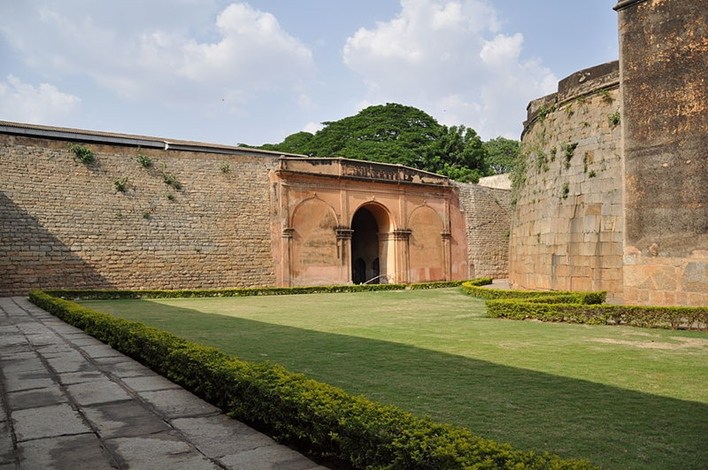
The Bangalore Fort and Tipu Sultan’s Palace stand as profound reminders of Bengaluru's rich and tumultuous past, embodying the grandeur of the Mysore Kingdom and the fierce resistance of Tipu Sultan against British forces. Situated near the bustling Krishna Rajendra City Market, at the intersection of Krishna Rajendra Road and Albert Victoria Road, this complex is a pivotal landmark. The palace, often referred to as ‘Rash e Zannat’ or 'Envy of Heavens' by Tipu Sultan himself, served as his beloved summer retreat and is a marvel of Indo-Islamic architecture, celebrated for its intricate design and historical significance. It continues to draw visitors into the historical narrative of one of India's most valiant rulers.
The origins of the fort date back to 1537 when Kempe Gowda I, the visionary founder of Bangalore, constructed a mud fort with an impressive perimeter of one mile, surrounded by a protective trench and featuring nine gates. Over the centuries, it underwent significant transformations. In 1761, Hyder Ali, Tipu Sultan's father, renovated and strengthened the fort with stone, laying the groundwork for its subsequent enhancements. The construction of the current stone fort was initiated by Hyder Ali in 1781 and magnificently completed by Tipu Sultan in 1791, solidifying its strategic importance. The fort witnessed significant battles, including the pivotal siege of 1791 by the British East India Company, which led to its capture after fierce resistance.
Tipu Sultan’s Palace, often called the ‘Abode of Happiness,’ is a breathtaking two-story structure constructed entirely of teak wood, resting on a robust stone plinth. Its architectural beauty is defined by exquisitely carved wooden pillars, which support giant wooden beams and are adorned with delicate brackets and curved arches. These pillars feature intricate designs at their bases, creating the illusion of emerging from blooming flowers, while the walls and ceilings are embellished with beautiful floral motifs, all painted in vibrant colors characteristic of Indo-Islamic art. The first floor is accessible via four staircases leading to a grand hall, flanked by four 'Zenana Rooms' at its corners, historically reserved for the royal family's female members. The sultan famously addressed his state officials from the two projecting balconies on the east and west sides of this hall, holding his Durbar from within.
Today, the ground floor of the palace houses a fascinating museum, displaying a rich collection of artifacts and antiques from Tipu Sultan's era. Visitors can admire the king's crown and garments, intricately embedded with gold and silver, alongside silver vessels gifted to Hyder Ali by a general. The museum also features portraits depicting people and places of that period, offering a vivid glimpse into the royal lifestyle and the chivalry of the Mysore King. Within the fort complex, a spectacular Lord Ganesha Temple, built in 1790, stands as a testament to Tipu Sultan's respect for all religions. An art gallery further enriches the visitor's experience, showcasing paintings, pictures, photos, and delicate carvings from the past. The Tipu Sultan Fort and Palace remain an iconic monument, not only attracting tourists year-round but also serving as a significant site for historians and archaeologists.
Visitor Information
Famous For
Tipu Sultan's summer palace, Kempe Gowda's original fort, Indo-Islamic architecture, teak wood construction, historical battles, museum showcasing artifacts of Tipu Sultan.
Visit Duration
1 to 2 hours
Best Time
Mornings (8:30 AM–11:00 AM) or late afternoons (3:00 PM–5:30 PM) to avoid the heat. The cooler months from October to March offer the most pleasant weather for visiting.
Route Options
Located in New Tharagupet, Bengaluru, it is easily accessible. You can reach by local BMTC buses, auto-rickshaws, ride-sharing services (Ola/Uber), or taxi. The nearest Metro station is Krishnarajendra Market (Green Line), a short walk away.
Parking
Limited paid parking available nearby, possibly street parking in designated areas or private lots at some distance. It's advisable to use public transport or ride-sharing during peak hours.
Entry Fee
INR 15/- per head for Indian nationals, INR 200/- per person for foreign nationals.
Camera Fee
INR 25/- per camera.
Restaurants Nearby
Numerous local eateries, cafes, and multi-cuisine restaurants are abundant in the surrounding KR Market and Bengaluru city area, catering to various budgets and preferences.
Toilets
Public toilet facilities are available within the complex or very close to the entrance for visitors.
Drinking Water
Bottled water is available for purchase from vendors near the entrance. It's advisable to carry your own water bottle, especially during warmer months.
Wheelchair Access
The ground floor of the palace and some fort areas may be accessible via ramps or relatively even paths. However, the upper floor of the palace (Zenana rooms) and some parts of the fort involve steps and uneven terrain, limiting full wheelchair accessibility.
Medical Facilities
First aid can be availed on site from security personnel. Major hospitals and clinics are readily available within a few kilometers in central Bengaluru.
Weather Alerts
Monsoon season (July-September) can bring heavy rainfall, making outdoor exploration challenging and paths potentially slippery. Check weather forecasts before visiting.
Pilgrim Information
Darshan Timings
For the Ganesha Temple within the fort complex, typically open from 8:30 AM – 5:30 PM, aligning with the fort's operational hours. Devotees can offer prayers during this time.
Special Poojas
Simple offerings like coconuts, flowers, and incense sticks can be made. Specific daily aratis or small poojas are performed by the temple priest; timings vary but are usually in the mornings and evenings.
Prasadam
Simple prasadam (e.g., modak, ladoo, or sweets) may be offered by the temple priest, especially during festivals or on Tuesdays and Fridays. This is usually a small, token offering.
Free Meals (Bhojan)
No free community meals (annadanam) are provided at this small temple within the fort complex.
Temple History
The Ganesha Temple within the fort complex was built in the year 1790, a testament to Tipu Sultan's policy of religious tolerance and respect for other faiths within his domain.
Nearby Sacred Places
Other significant temples in Bengaluru include Bull Temple (Dodda Basavana Gudi), ISKCON Temple Bangalore, and the Kote Venkataramana Temple, all within a reasonable distance.