BIDAR FORT
Address
BIDAR
Open Hours
9:00 AM–5:00 PM
Weather
Pleasant in winter months; hot and dry during summer.
Crowd Level
Medium
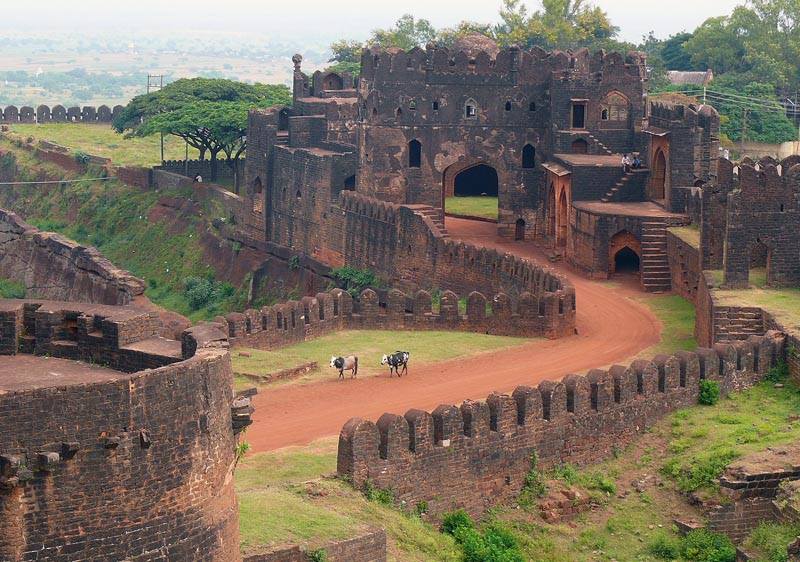
Bidar Fort, located in the heart of Bidar, Karnataka, stands as a monumental testament to India's rich medieval history. Situated approximately 2.5 km from the Bidar Railway Station, this sprawling architectural marvel reflects the transition of power across dynasties, ranging from the Western Chalukyas of Kalyani to the Bahmani Sultanate. Originally established during the Chalukyan era in 977 AD, the fort gained its current grandeur when Sultan Ahmed Shah Wali of the Bahmani Dynasty shifted his capital from Gulbarga to Bidar in 1430 AD, ushering in an era of exquisite Persian-influenced architecture.
The fort is renowned for its unique quadrangular layout, spanning 1.21 km in length and 0.80 km in breadth. It is heavily fortified with three miles of robust stone walls, 37 formidable bastions, and an intricate system of triple moats designed to repel invaders. The entrance to this majestic structure is marked by seven distinct gates, most notably the Gumbad Darwaza and the Sherza Darwaza, the latter featuring iconic tiger carvings that have become a signature of the fort’s historical aesthetic. The Munda Burj, a prominent bastion near the entrance, still houses ancient cannons that speak to the fort's strategic military past.
Beyond the defensive walls lies an expansive complex filled with remnants of the Bahmani and Barid Shahi eras. Significant structures include the Gagan Mahal, Rangin Mahal, and Tarkash Mahal, which showcase the refined aesthetic tastes of the medieval Sultans. Visitors can also explore the Jami Masjid and the sixteen-pillared Solah Khamba Masjid, both quintessential examples of early Islamic architecture in the Deccan region. These structures served as the nucleus of the administrative and religious life of the Sultanate.
The inner precincts house the Diwan-i-Am (Jali Mahal) and the illustrious Diwan-i-Khass (Takht Mahal). The Takht Mahal, or Throne Palace, remains the most historically significant, having served as the site for the coronation ceremonies of multiple Bahmani and Barid Shahi rulers. While the palace features elaborate tile work and stone carvings, parts of which are preserved today, visitors are restricted to viewing the exterior sections. Tucked away behind these royal structures is the ancient Valkoti Bhavani temple, a fascinating inclusion that highlights the cultural synthesis often found within the fort complex.
Today, the Bidar Fort is recognized as one of the best-preserved monuments in Karnataka. Its layout, which incorporates military might with artistic finesse, makes it a premier destination for history enthusiasts, architecture students, and tourists. The site offers a glimpse into a time when Bidar was a major center for arts, trade, and learning in the Indian subcontinent.
Visitor Information
Famous For
Persian architectural style, Bahmani-era palaces, Solah Khamba Masjid, and historical military bastions.
Visit Duration
3–4 hours
Best Time
Early morning or late afternoon for comfortable exploration.
Route Options
Accessible via Bidar Railway Station; local auto-rickshaws and taxis are available from the city center.
Parking
Designated parking area available near the main entrance gates.
Entry Fee
Rs. 25 for Indians, Rs. 300 for foreigners.
Camera Fee
Rs. 25 for professional still cameras.
Restaurants Nearby
Various local restaurants in Bidar city serving North Karnataka cuisine.
Toilets
Public toilet facilities provided near the fort entrance and parking zone.
Drinking Water
Filtered water dispensers available near the main gate.
Wheelchair Access
Partial accessibility; main pathways are paved, but palace interiors involve stairs.
Medical Facilities
Several private clinics and the District Government Hospital are within 3 km.
Weather Alerts
Summers can be extremely hot; maintain hydration.
Pilgrim Information
Darshan Timings
Temple open from 8:00 AM to 6:00 PM daily.
Special Poojas
Special daily prayers and seasonal offerings on Hindu festival days.
Prasadam
Limited offerings available; devotees usually bring personal items for puja.
Free Meals (Bhojan)
No dedicated annadanam; community food stalls operate in the city.
Temple History
The Valkoti Bhavani Temple is an ancient shrine hidden within the fort's landscape, surviving through the eras of the Bahmanis and the Barid Shahis.
Nearby Sacred Places
Nanak Jhira Sahib Gurudwara and Papnash Shiva Temple.