Situated in the northernmost part of Karnataka, Bidar is a city deeply steeped in rich historical, architectural, and spiritual heritage. Historically part of the Chalukyan Empire, Bidar later rose to immense prominence as the magnificent capital of the Bahmani Kingdom in the 15th century and subsequently the Barid Shahi dynasty. The city seamlessly weaves together Islamic medieval architecture, ancient Hindu cave traditions, and sacred Sikh pilgrimage sites.
Key Historic & Architectural Highlights:
- Bidar Fort: As visitors approach Bidar, the towering Bidar Fort welcomes them with five formidable Darwazas (gates) that open into a historic precinct protected by triple-moat ramparts. Within the fort complex lie exquisite structures:
- Rangeen Mahal: The royal residence famous for its elaborately carved wooden pillars, Persian couplets engraved on walls, and magnificent Mother of Pearl inlay work.
- Sola Khamba Masjid: Built in 1327, this is the oldest monument in the fort and one of the largest mosques in India, named after its sixteen massive columns.
- Palaces & Pavilions: Remnants of the royal Chini Mahal, Turkish Mahal, Gagan Mahal, Takht Mahal (Royal Pavilion), Hazar Kothari, and Naubat Khana. The Diwan-E-Am once housed the legendary turquoise throne.
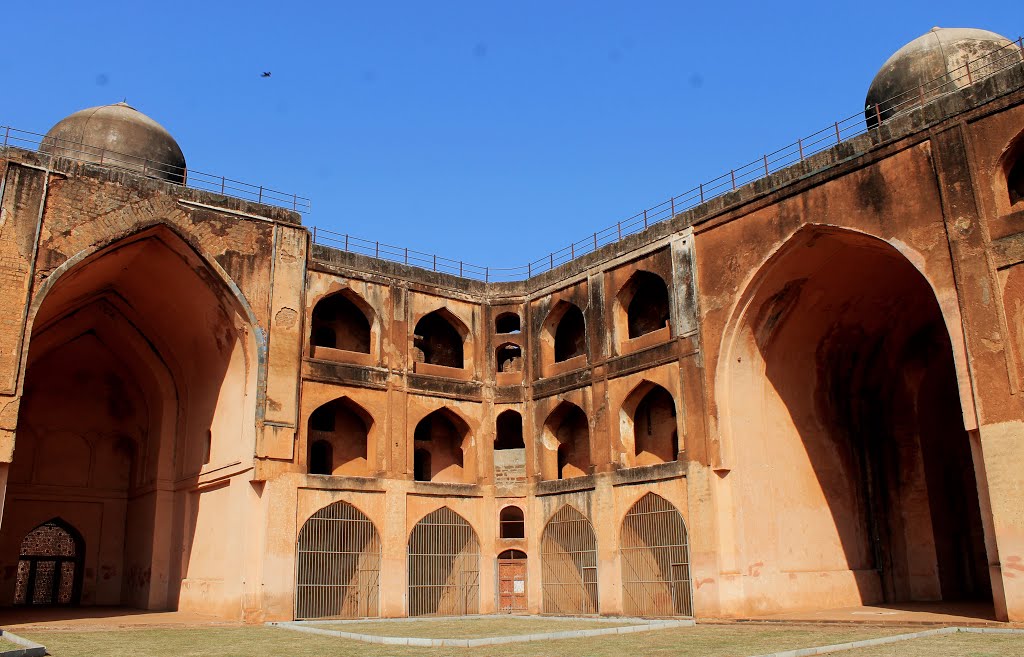
- Mahmud Gawan Madrasa: Constructed in 1472 by Khwaja Mahmud Gawan, this imposing three-story Islamic university was an internationally renowned center of learning attracting scholars from across the Islamic world.
- Chaubara: A striking 27-meter-high cylindrical watchtower standing in the heart of Bidar city, now functioning as a clock tower.
- Bahmani & Barid Shahi Tombs at Ashtur: Splendid royal mausoleums located on the outskirts, featuring large domes, intricate tilework, and Quranic calligraphy.
- Narasimha Jharni (Jharni Narasimha Cave Temple): A unique pilgrimage shrine located inside a 300-foot natural cave. Devotees walk through waist-deep natural spring water to pay homage to Lord Narasimha. Electric lighting now guides pilgrims along the water cavern.
- Gurudwara Nanak Jhira Sahib: A major Sikh pilgrimage center built near a natural freshwater spring created by Guru Nanak Dev Ji during his visit to Bidar.
Bidar Fort, Mahmud Gawan Madrasa, Narasimha Jharni Cave Temple, Gurudwara Nanak Jhira Sahib, Bidriware craft
👕 Dress Code & Rules
Modest attire required for temples, mosques, and gurudwaras. Head covering required at Gurudwara Nanak Jhira Sahib.
Entry Fees:
Bidar Fort: ₹25 for Indian citizens, ₹300 for Foreign tourists; Free entry at Narasimha Jharni and Gurudwara
Bidar Fort: ₹25 for Indian citizens, ₹300 for Foreign tourists; Free entry at Narasimha Jharni and Gurudwara
Parking:
Ample parking available at Bidar Fort, Gurudwara, and Narasimha Jharni temple premises
Ample parking available at Bidar Fort, Gurudwara, and Narasimha Jharni temple premises
Nearby Food:
Hotel Kasturi, Imperial Restaurant, Punjabi Rasoi (near Gurudwara), Shilpa Restaurant
Hotel Kasturi, Imperial Restaurant, Punjabi Rasoi (near Gurudwara), Shilpa Restaurant
Open Hours:
Bidar Fort: 6:00 AM – 6:30 PM; Narasimha Jharni: 6:00 AM – 7:00 PM; Gurudwara: 24 Hours
Bidar Fort: 6:00 AM – 6:30 PM; Narasimha Jharni: 6:00 AM – 7:00 PM; Gurudwara: 24 Hours